Dear Elm Tree fams,
Today was the half-way
point of the program, which is a trip for Romy and Rod—it feels like just yesterday that we were lounging on our
couches, perfecting our lessons plans and passionately scouring books for the
poems that we hoped would speak to your children. And now here we are!

We started our day by
heading over to Brooklyn Museum, where we had a little surprise in store for
the kiddos. Before going into the museum for a day of radical learning, we had
the kids drop their bags and run headfirst into the museum lawn sprinklers.
Romy and Rod have passed by many times and dreamt of running through
themselves, so today they lived vicariously before joining the kids themselves.


As other camps began arriving to the museum in perfect lines and crisp, dry clothing, our kids were drenched, muddy and dripping, the sounds of their screams echoing through the museum's glass windows. Annabel took note of the surrounding groups of camps, and noted said: "I feel like there are uncivilized camps and civilized camps, and we're an uncivilized camp." The irony of a bunch of poets looking grimier than some of the rugged, outdoor summer camps was not lost on us.


It took about five
minutes of time in the sun during snack time for the kids to dry off, and once
they did, we were on to the museum. We entered the Elizabeth A. Sackler Center
for Feminist Art. Before walking through the doors, we had the kids gather
around and discuss what they believed a "feminist" was. The start the
conversation, we asked the museum employee by the entrance to give us her take
on the word. Haley broke down her interpretation of the word for the kids: “a
feminist is someone who believes in equal rights for everybody.” When we asked
the kids if they would consider themselves feminists, they all nodded intently.
We asked them, “Can boys be feminists?” The kids, again, said yes emphatically.
Before walking through the doors, we asked them to raise their hands if their
fathers were feminists. We were happy to see all ten hands raised sky high.


The kids prompted our
first stop once inside: Judy Chicago's "The Dinner Table". This piece
is part of the museum's permanent collection, and features a triangular dinner
table with thirty-nine place settings, each with a plate that featured a
sculpture at its center. The place settings were each dedicated to an important
women throughout history. We made sure to point out the writers who had claimed
a seat at the table: Virginia Woolf and Emily Dickinson, among others. We had
the kiddos walk around the entirety of the table and take in the individual
place settings while thanking each woman for their individual and collective
impact.


This piece is one of the most significant pieces of art to emerge out
of the twentieth century, and the kids were truly enchanted by the space. We
were so pleased to be sharing this piece with them, and use it as a jumping off
point into the reason for our visit, We
Wanted A Revolution: Radical Black
Women, 1965-85.


This exhibit featured works by a number of prominent black female artists and activists, all working in a variety of mediums, including photography, video art, sculpture and painting. Additionally, the exhibit culled together historical signage and paraphernalia, including magazines, pamphlets, and photographs. As we entered, the kiddos were amazed at the variety of materials in use. Maren was particularly taken by the geometry of Virginia Jaramillo, whose artwork bookended the first room by appearing on opposing walls. The kids were particularly taken by the video art, but not just because they are like moths to a flame when in the vicinity of a screen—they were all genuinely enthralled by the actions of the women in the pieces. Gayatri was particularly focused on these pieces, especially Barbara McCullough’s Water Ritual #1: An Urban Rite of Purification (1979). We couldn’t tear her away.


As we turned the corner,
we came into the exhibit’s second room, which featured a photograph by Lorna
Simpson: Waterbearer (1986). Our
lesson from yesterday, which asked the kids to really consider the weight of a
single word, played heavily into the analysis of this piece and the
accompanying text. The kiddos spent time trying to figure out what the use of
the word “discount” means in the context of the piece.


We paid close attention
to the way in which the woman’s face remains unseen in the photograph, using
that as a way to consider the subject of the photograph to be the universal
black woman. The kiddos helped us discuss the representation of the water, and
whether the act of pouring it out was meant to telegraph the ‘discounting’ of
the subject’s memory. Again, the kids
gravitated toward this piece and lead this discussion!
Around the corner was
another Lorna Simpson piece, again taking up a sizeable amount of the wall
space. Simpson was a particularly great focus for our visit, largely because of
her fusion of imagery and text. Her work utilizes words—which the kids
excitedly identified as poems—in order to bridge the gap between photography
and storytelling. In Gestures/Reenactments
(1985), Simpson again hides the entirety of her subject’s face. Ajay was
particularly fond of this piece, and we used the texts below each photograph as
an opportunity to have the kids practice reading aloud.


Before leaving the museum, we made sure to have the kids take a second and observe the entirety of the exhibit. This room, we reminded them, exclusively displayed works by women of color, the very people these walls have historically shut out. For decades, women, particularly women of color, were largely kept out of the art world. Their work—and by extension, their voices—were rarely valued. During the very years that these works were made, it was, by a large, unimaginable that a museum would ever dedicated an entire retrospective to their celebration. We felt it was important to contextualize our experience at the museum with this fact.
With that, we headed
back to our trusty spot on Mount Prospect Park, laid out our tapestry, and had
a much-needed lunch break.


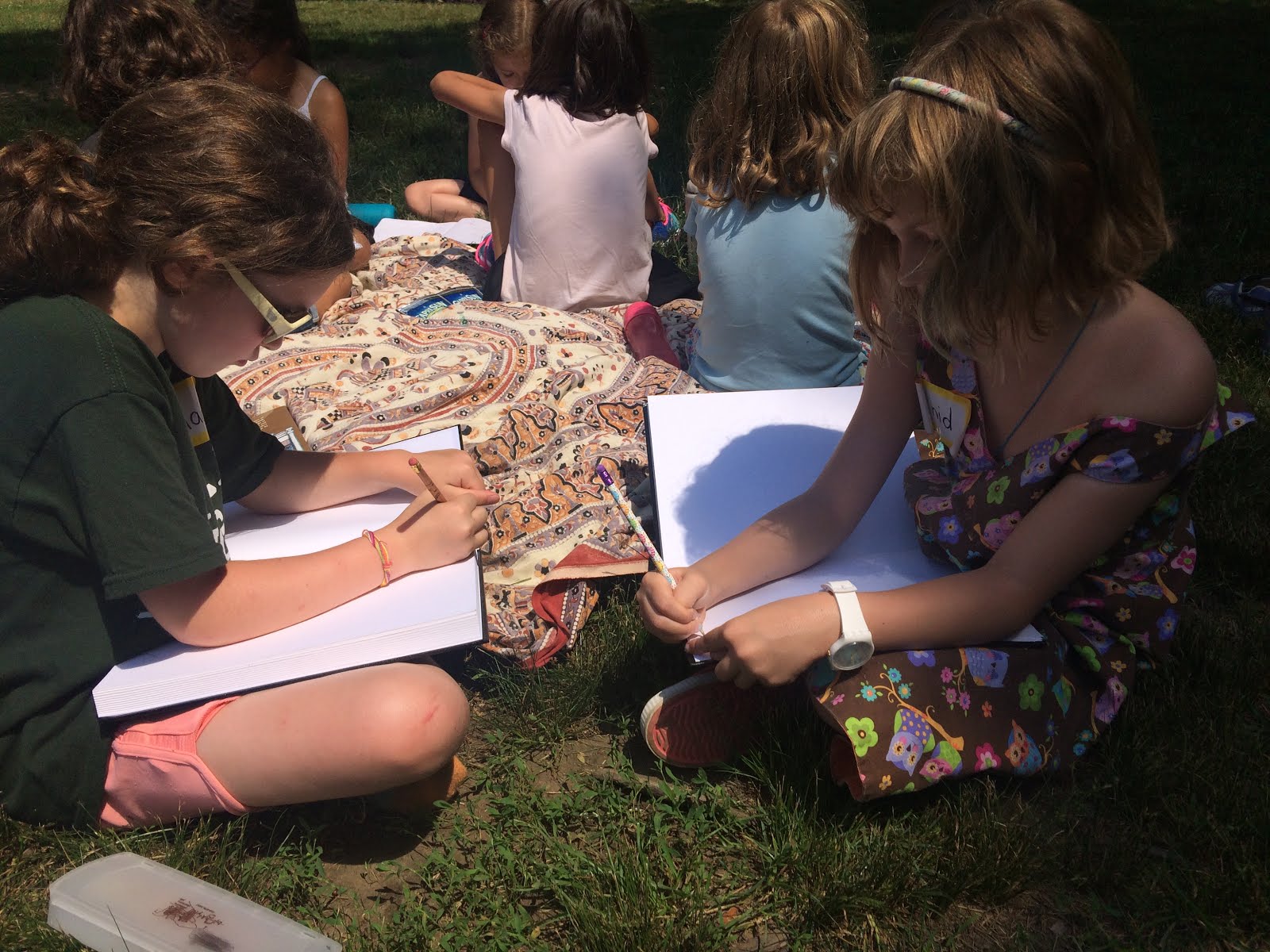
Following lunch, we had
the kids grab their notebooks and sit in a circle as Romy and Rod began a
discussion on the subject of women who helped change the world. We had the
kiddos close their eyes and think about women throughout history that left on
impression on them. We went around and shared some: Ella Fitzgerald, Amelia
Earhart, Rosa Parks, J.K. Rowling, Helen Keller, Eleanor Roosevelt, Malala
Yousafzai and more. This lead into our introduction of Odes. Odes are a form of
lyric poem that directly address a subject (be it a person, place or thing)
with the intention of celebrating their existence. They are in many ways love
poems.


In order to emphasize
the typical form of odes, Romy shared a poem she wrote this morning while
waiting for the kiddos to arrive, an Ode
to Patsy Cline. We used this as an example of how odes employ repetition of
a subject’s name as a constant direct address. She also specifically wrote
one-word lines to break the children free of their sentence-bound framework.
 |
| Ode to Patsy Cline by Romy Feder |

Ode to Helen Keller by Enid

Ode to Amelia by Maren


Ode to Emma Watson by Annabel

Ode to J.K. Rowling by Oona

Ode to J.K. Rowling by Oona


Ode to Trouble by Maddie

Ode to Hillary by Ajay


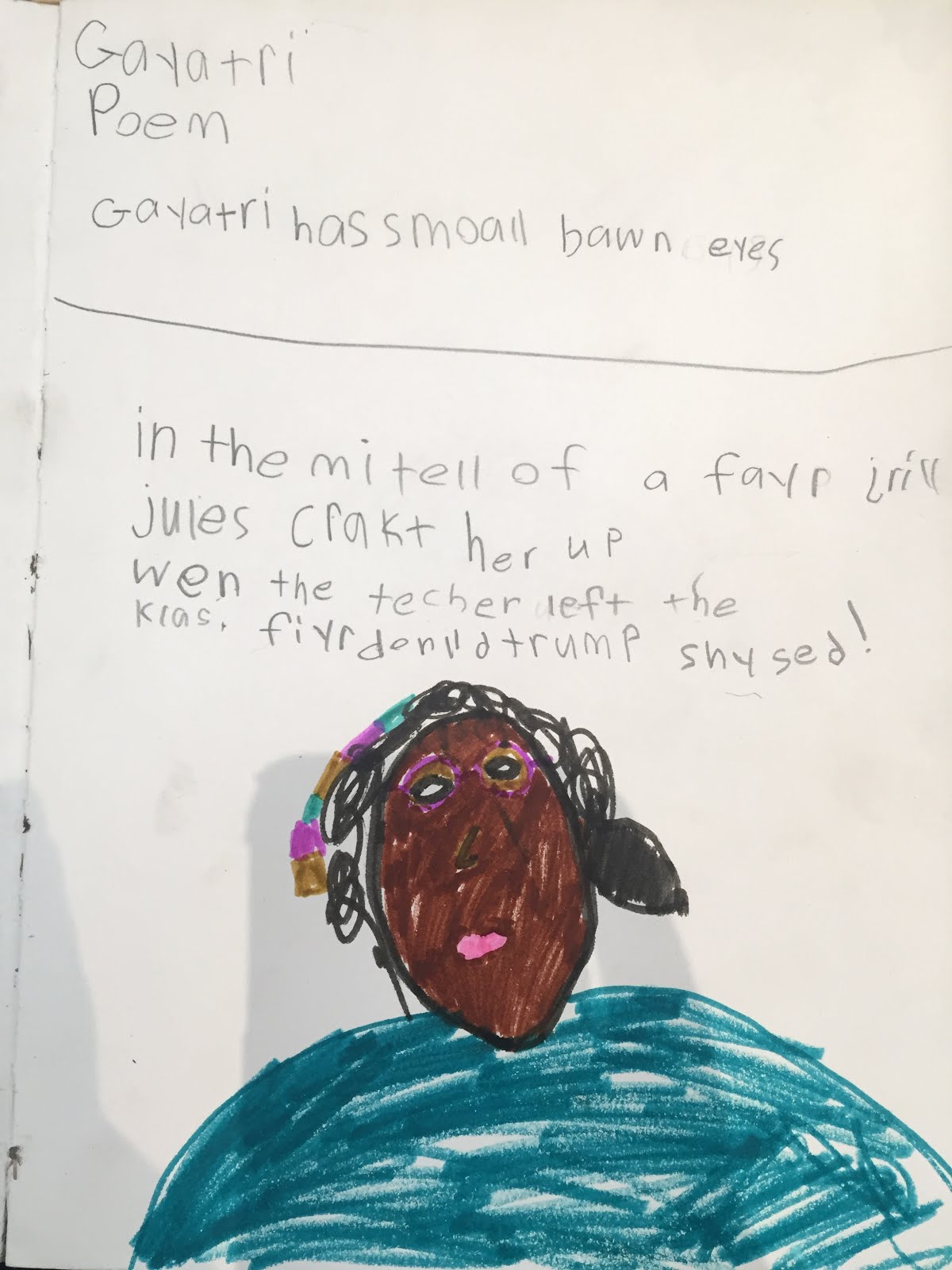
Ode to J.K. Rowling by Gayatri

Ode to Amelia by Lyla

Ode to Eleanor by Audrey
The themes of the day
were certainly loaded, but the children were so inspired by the exhibit that their
odes flowed out of them effortlessly. They all showed remarkably growth just
between Tuesday and Wednesday, and really made mention of how much they loved
the form. We will be sure to play around with odes further before the end of
the week.
Your kiddos are rad.
Cheers to Herstory,
Romy & Rod